


What We've Built Together
Updated: Jul 29
Newsletter October 8, 2025 Together, we're #keepingitsacred...

This past Saturday's gathering for our 5 year Keeping It Sacred Anniversary was a dream. An absolute dream. It will take me time to process how special it was and so I will include bits from the gathering in the next couple of newsletters. Stay tuned!
Not only did we have a full house present in person in Studio City, CA, but we also enjoyed the participation of so many of our beloved members online. We heard from 5 members about what Keeping It Sacred means to them, and honored several with awards for Community Partnership, Leadership, Peacemaker, and Commitment to Accessibility Award. Mazal Tov to Pastor Cue, Wendy, Sheryl, David, Tracy, Ashleigh, Dan, Diana, Stu and Linda!
Also, this past month, 427 tickets were claimed for our events. Our Yom Kippur Kol Nidrei service was enjoyed in person and online by over 100 people (more than that because many zoom accounts included more than one person).
But more than numbers, it is the spirit of our community that brings me the most joy and gratitude. To know that the people who choose to associate with Keeping It Sacred, each of you who gather together in community, are people who feel all the contours of life and hold sacred space for each other.
I want to thank my amazing prayer partners, staff, and program participants including:
TEAM MEMBERS: Cantorial Soloist Rachel Rothman, to our Digital Marketing Director Molly Flanagan and Technical Support Tamir, to our second day Rosh Hashanah leader Kimberly Duenas, to our song leader and storyteller Max, and support staff Aaron and Brandon,
OUR AMAZING ANNIVERSARY EMCEES: Amanda and Geoffrey, who brought the best spirit of love and joy and authentic celebration, and
OUR ANNIVERSARY SPEAKERS: Rabbi Jim Kaufman (who has known my family for generations including my grandma Kit for whom Keeping It Sacred is named), and Heidi Segal (who represented the Union for Reform Judaism and who serves as board member of the Reform Movement's Commission on Social Action), all of whom shared truly heartwarming messages, as well all Keeping It Sacred members who shared touching testimonials (view them HERE) of what Keeping It Sacred has meant to them including: Alex, Erin, Matthew, Nassim, Troy, Casey, Corinne, and Alpie,
ALL WHO PARTICIPATED IN SERVICES AND THE ANNIVERSARY: including Tracy, Melissa, Julius, Leo, and everyone who stepped up to honor Torah with an Aliyah or bringing art projects (Diana!), those who helped in a myriad of other ways (Chelsea!), all who contributed gifts of financial support to our community in honor of our five year anniversary, and those who hosted our spaces and those who held space for one another online and in-person.
The successful programming in the past couple of weeks was the result of countless hours and efforts and good will of many, and for that, I am grateful!
In the pages of this newsletter, you will find snapshots of the love and joy and respect that is cultivated in this sacred community. Whether photos or video snippets from our awards ceremony, words from our High Holy Day sermons, or our community family photo, each of YOU are the true blessing of Keeping It Sacred. You hold that space for one another in beautiful ways. Thank you for keeping it sacred.
Together, we’re #keepingitsacred...
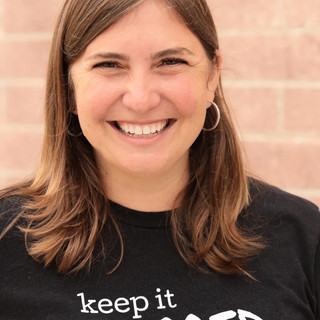
Rabbi Heather Miller
Founder, Keeping It Sacred

Top: Some of our in-person 5th Anniversary participants!
Above: Some of our online 5th Anniversary participants!
Below: Our KITS global family map of just some of our members placed on or near their home cities-- and it's continually growing!

Below: One of our members delivering part of our anniversary cake to fellow nurses at Cedars-Sinai Medical Center.

HIGH HOLY DAYS 2025 RECAP
The High Holy Day season concluded last week, as well and a HUGE THANKS again go out to our entire staff team that made it all possible.
We enjoyed gathering with unprecedented numbers of people across ten days and 8 core services that incorporated varying degrees of participation, moving the community through timeless liturgical classics with a relevant spin.
Please enjoy the texts of Rabbi Miller's sermons, and find links also to Cantorial Soloist Rachel Rothman's select musical offerings in the coming newsletters.
ROSH HASHANAH SERMON:
THE POWER OF A LETTER, THE POWER OF OUR FRAMING
By Rabbi Heather Miller
Here’s a good fact. I love a good fact. Do you know what the letter of the Torah starts with? We just saw it, what was that letter that we just saw? You might think the Torah starts with the letter alef, right? That would only make sense, the first letter of the Hebrew alphabet should start with an alef.
But it doesn’t. Why doesn't it? That is the question. It starts with the letter bet. So what is so special about that bet?
The rabbis looked at this question and then they looked at the shape of the letter. The letter’s shaped like a box, as we saw in the Torah earlier, with the left side open. But there’s a dot in the middle.
And then they noticed that they read the Torah from right to left. So what happened was that the Rabbis imagined you are that dot. The person in the middle of the box. And there are three walls surrounding you—shielding you from what is above, behind, and what’s below. That way it orients you to not think too much about what’s above you, behind you or below you, but it points your focus on what’s right there in front of you. What’s next ahead.
And in noticing this and in calling this out, the rabbis were teaching a lesson that a person shouldn’t think too much about heaven above, the underworld below, or what happened in the past. But to focus all of our energy and attention on what’s next in the future.
Or as Oprah says, “Make the next right move.” Or as Elsa said in Frozen 2: focus on “the next right thing.” What is in front of you. Focus on what’s in front of us, the things that are ahead.
Yes, this is a whole transformative teaching imaged by the Rabbis about just one letter of the Torah—welcome to Judaism!
So, the Torah begins with this one sacred letter. And then it begins with the account of creation which I just read. The account (Genesis 1:1-3) that says “In the beginning…
בְּרֵאשִׁ֖ית בָּרָ֣א אֱלֹהִ֑ים אֵ֥ת הַשָּׁמַ֖יִם וְאֵ֥ת הָאָֽרֶץ׃
When God began to create the heaven and earth—
וְהָאָ֗רֶץ הָיְתָ֥ה תֹ֙הוּ֙ וָבֹ֔הוּ וְחֹ֖שֶׁךְ עַל־פְּנֵ֣י תְה֑וֹם וְר֣וּחַ אֱלֹהִ֔ים מְרַחֶ֖פֶת עַל־פְּנֵ֥י הַמָּֽיִם׃
the earth being unformed and void, with darkness over the surface of the deep and a wind from God sweeping over the water—
וַיֹּ֥אמֶר אֱלֹהִ֖ים יְהִ֣י א֑וֹר וַֽיְהִי־אֽוֹר׃
God said, “Let there be light”; and there was light.
Sometimes it’s hard to focus on what’s in front of us especially amidst all of that chaos. There’s so much in the world that tries to steal all our attention and energy. Doomscrolling on social media is one of those things and it's designed this way to pull us into a moral outrage and all of those feelings of ick and despair and offense.
One day, while swiping UP to consume more and more internet dross, I came upon a post on an Instagram story of one of our members who is a therapist—so I knew it would be good. They posted a post from a comedian and writer named Tom Fell, who insisted that we “COMPLETELY disengage—because almost everything on the internet is bait to engage your most extreme emotions which is why it feels so awful and euphoric at the same time to be on it, but to be honest it's mostly awful.” (Instagram, 9/19/25, @tomfell)
I mean there are some amazing wedding videos out there and some cuddly pet videos sprinkled in, we all know that, but then out of nowhere the algorithm feeds into the lineup the kind of news post or hate filled opinion that makes you want to let out a primal scream.
Now, yo-yos are fun toys but when it's your emotions yo-yoing up and down rapidly like this—it is no fun. And sadly it has become addictive. And really, what are we doing when we do this? Does it help the world to feel like there’s no hope? That there’s only despair?
Enter today—this holiday—this day of renewal and hope. This day of tikvah—this day of hope. Today is known as HaYom Harat Olam, “Today is the birthday of the world.” Today, we recognize this day as the birthday of the world—it’s like a newborn baby, today, and everyday is a day born full of potential and full of promise.
God created this miracle of time and possibility. And that is an incredible gift that we have been given. But this baby needs our care, it needs our guidance, our love and effort to rear it. We are the caregivers of this new world that is developing with every moment. God births, but we parent. So how do we want to parent. How do we want to show up in this world.
A true story:
Last week I hopped in my car one day and I turned on KBLA—Talk Radio 1580 AM if you’re in LA. And a program was on, hosted by our friend and seasoned radio talk show host, Dominique di Prima. And a caller called into the show lamenting the state of the world. Now, this was last week, right after the Jimmy Kimmel show was indefinitely suspended. And he was going into the same doomsday lamenting that I’m pretty sure most of us were engaged in last week.
And her response? Her response was to ask him—so what are we doing about it? And he started talking about writing letters to ABC and to Disney and even to the FCC. And she said yes, we can write letters to ABC and to Disney and even to the FCC. But then she hit him with reality. She said, “What are those letters going to do, really?” Now, even if he’s put back on air, which thankfully he will be tonight, what will that do to fundamentally change the dynamic of the corporate conglomerate controlling the narrative?
He was stopped in his tracks. And, frankly, so was I. Because I was right there with him, ready to yell into the abyss and try my hand at being a keyboard hero.But her comment made me freeze. Her question made me think. Her question made me stop and analyze, because it was deployed as a masterful tool of the Socratic Method—where a wise teacher asks her student a question to lead them to their answer themselves.
And before we could answer, what are we going to do, she asked: What are we doing to support institutions that are building a new way forward? To support local journalism and organizations that are building something else? That thing that we want to see built.
In essence, she was asking: Are we just consuming despair, or are we co-creating hope?
That is the question. That’s the question of our day today and that’s a question the rabbis asked two thousand years ago. What are we doing to help care for this new world that was birthed on this new day? And what ways are we co-creating with God to help finish an unfinished world?
Or as the Jewish mystical work known as the Zohar says:
“God looked into the Torah and created the world. The human looks into Torah and sustains the world.” (https://www.sefaria.org/sheets/597834.371?lang=bi&with=all&lang2=en)
So what are we doing to sustain the world? Are we doing the work to nurture the world into a way that it should exist? It can be overwhelming.
And when it gets to feeling overwhelming, we can remember that little letter—that little letter bet. The little letter that could. Reminding us that we don’t need to do it all. We only need to focus on what’s in front of us.
To make that next right move. It could be making a good move in a family dynamic, or with regard to curbing a habit. It might mean doing something nice in a community space, or turning some hurt into healing. Wherever you see a lack, you look to help.
In essence, we don’t control the weather, but we can plant, we can water, we can weed. We can tend the garden. We can ready the soil. We can make sure the goodness we want to see has what it needs to grow.
Earlier this year I wrote a poem for the Women of Rabbinic Judaism, they asked many of us – and the book is poetry on social justice and I used the planting metaphor as well, my poem is this, “Planting Evermore,” and I’m going to dedicate it to each of you because I know you’re like me, you have earth under your fingernails.
Planting Evermore
There is earth under my fingernails.Just like the ones who came before meand those who came before them as well.
We are a people who work the land.Tilling it with swing after swing of sharp objectsunder the blazing sun.
We are committed to the blistering work,dedicated to the process of opening things up.Dedicated to transforming hardened land tosoft earth ready to receive seeds. The seedsof all that we wish to grow. Seeds of compassion.Seeds of intellect. Seeds of justice.
We tend the land knowing that it demands of usthe keenest of attention.We remember when once something else gotin the way. And our labors were lost.As if erased by entropy encroaching in.
And so we plow and till and plant and tend.Diligently.The seeds of compassion, intellect, and justice.And we wait patiently for the fruits of our labors,sweet peace, to ripen on the branch,for all children to taste.
("Planting Evermore," by Rabbi Heather Miller as found in Covenant of Justice: Prayers, Poems, and Meditations from the Women of Reform Judaism, ed. Rabbi Marla Feldman, WRJ, 2025)
Keeping It Sacred community– I know we are the gardeners. I know each of you, and for each of you, there is already soil under your fingernails. This is what it means when we say that the Torah is not in heaven. That's the way this little story ends.
There’s a story where one rabbi is arguing with the others about whether an oven is kosher or not. And this rabbi looks to the heavens and he says if the tree agrees with me, make the tree move. And it did. Then he asks if the river agrees with him, let it show, and the river flowed backwards. And then he asks the walls of the study house if it agreed, and the walls of the study house nearly caved it, when all of the other rabbis protested and said wait wait wait, and just then, boom, a voice in heaven called out and said, “the Torah is not in Heaven.” (Babylonian Talmud, Bava Metzia 59a-b)
We shouldn’t look to heaven for the answers. Everything is up to us to work out for ourselves. We can’t rely on supernatural signs and portents. We have to roll up our sleeves and solve some things for ourselves.
That's what the midrash about the Oven of Aknai says. We can’t ask God the answers to our biggest questions – the answers are not in heaven. They lie with us. We have to find our way forward ourselves. It’s like this by design. It’s up to us to co-create the world. Or as Gandhi says: “to be the change that we wish to see in the world.”
So great news, the fulfillment of this mitzvah, this sacred obligation, is open to anyone and everyone. We all have a role to play in this rearing of the world.
The question to sit with today is what is one thing in front of you today—just one thing– that you can help build or nurture for our collective future together?
What is some act of encouragement for someone, some nurturing of some space that you love that you can do? What is one thing you can do to help build the future that we collectively need? When we all ask these questions, around the world, as our Keeping it Sacred community is, the world won’t be able to do anything but be moved by our goodness, I really believe that.
So, may this year bring fewer tweets and more fruit on the vine! Less kvetching and more common sense and action! Less talking and more action. And, together, may we build the world we wish to see. May it be sweet, happy, healthy, peaceful, abundant, and prosperous for all. Amen!
KOL NIDREI SERMON:
WHERE GOODNESS PREVAILS
By Rabbi Heather Miller
Last month, Melissa and I took a walk along dirt Mulholland. For those not familiar with Los Angeles, this is the 8 mile stretch of unpaved road that serves as a dividing line between the city and the valley.
It’s known as a gorgeous path- and it was! Melissa and I walked along, we saw on one side a sprawling valley of 1.8 million Angelenos.
We saw the buildings, homes, and freeways with bustling cars, airports and airplanes taking off and landing, parks and lakes of the communities of Topanga, Woodland Hills, Tarzana and Encino.
And on the other side? We saw wavy hills of wilderness behind the communities of Malibu, Brentwood and the Pacific Palisades. You see, dirt Mulholland rose to prominence this past January as firefighters repeatedly used DC-10s to drop fire retardant along the line and, thank God, managed to hold the line, stopping the fire there.
So on that side of the path, we saw pockets of vegetation that
would have been densely concentrated, if not for the fires that tore through the area 7 months earlier.
It was surreal to encounter, on that side of the dirt road,
flame-scarred oaks and chapparal, patches of mustard and sumac. But what was really interesting was that even in the center of where the flames were presumably the hottest, on the higher parts of the hills, new life was budding once again.
Taking in this majestic and profound sight took me back
to the words of our sacred prayer, that iconic prayer of these Days of Awe—the Unetaneh Tokef, where we plead:
Who by fire… will be consumed?
Because this was clearly scorched earth, every bush charred, but it was not decimated. The landscape was coming back to life!
How on earth was it not consumed entirely? How on earth did it survive?!?
And survive not only the flames, but also the dropping of water and chemical retardant made of toxic components like ammonium phosphate and heavy metals. (https://rdrtechnologies.com/blog/fire-retardant-droppedplanessrsltid=AfmBOorC6JJ
0lcq5mKzM6XJ3yM9BvaUzsh18HqsEkbVRfsmrGhzpJGOk)
What is the source of the resilience of this flora?
And then I remembered another Jewish text: (Jeremiah 17:8)
V’hayah ka’etz shatul al mayim, v’al yuval y’shalach sarashav, v’lo yireh!
וְהָיָ֞ה כְּעֵ֣ץ ׀ שָׁת֣וּל עַל־מַ֗יִם וְעַל־יוּבַל֙ יְשַׁלַּ֣ח שׇׁרָשָׁ֔יו וְלֹ֤א (ירא) [יִרְאֶה֙] כִּי־יָ֣בֹא חֹ֔ם וְהָיָ֥ה עָלֵ֖הוּ רַעֲנָ֑ן וּבִשְׁנַ֤ת בַּצֹּ֙רֶת֙ לֹ֣א יִדְאָ֔ג וְלֹ֥א יָמִ֖ישׁ מֵעֲשׂ֥וֹת פֶּֽרִי׃
It likens people who trust God to,
“… a tree planted by waters, sending forth its roots by a stream. It does not sense the coming of heat, its leaves are ever fresh; It has no care in a year of drought, it does not cease to yield fruit.”
A tree planted by waters?! It certainly seemed like there was some Source that refreshed the leaves of these bushes, and it certainly seemed like it was unfazed by the blazing inferno that had passed. And it revealed new fruit.
These trees on the trail were much like the trees noted in Jeremiah. Resilient because of their access to life-giving waters.
There was only one problem. Melissa and I could spot no water on the trail.
There was no stream, no body of water around. Or so we thought. What Melissa and I realized was that the vegetation there was tapped into a deep well under the surface of the earth.
I don’t mean a literal well, but I mean the roots of these bushes penetrated the surface of the earth to access the groundwater.
And it struck me. We in the Keeping It Sacred community are like these trees. We may be scorched up by the fiery news stories that cycle on our TVs, our hearts might have melted with every story of every school shooting we learn of, our fears might have been ignited by antisemitism we face, we may be smoldering with outrage at the actions of political leaders, baked and branded and boiled with every awful mishap and we may feel like we are about to combust. Who by fire?! US!
But, ah… to be like the chapparal. Able to endure and not be consumed. If we could only be like that. Able to withstand and endure.
As I prepared for this service tonight and I took our Torah cover to the dry cleaner to be cleaned, I was struck by the message on the cover. It features a verse from Exodus which recalls the bush that was ablaze with fire, it was on fire but it was not consumed.
We read in Chapter 3 verse 2:
וְהִנֵּ֤ה הַסְּנֶה֙ בֹּעֵ֣ר בָּאֵ֔שׁ וְהַסְּנֶ֖ה אֵינֶ֥נּוּ אֻכָּֽל׃
V’Hinei hass’neh boer baesh vhass’neh ainenu u’chal.
“A messenger of Adonai appeared to Moses in a blazing fire out of a bush. He gazed, and there was a bush all aflame, yet the bush was not consumed.”
God appeared as this bush on fire but not consumed. In fact, it was the first encounter Moses had with God. And what a metaphor! In my childhood this image always perplexed me. Why did God appear as a bush and why was it on fire? But standing there on dirt Mulholland, it all came into focus. It was all apparent.
The message conveyed is that the presence of God, our Source, helps us withstand the heat we are subjected to in life.
We may feel aflame on the surface, but our survival lies
in something deeper.
And, what is the greater river under the surface that we might tap into to ensure our survival. What is the capital S “Source” that keeps you inoculated from the stresses of life?
If people are trees, what is the stream that keeps you fresh? Growing? Surviving?
What keeps you from being consumed when the world is so obviously on fire?
I ask these questions today because this year we have needed to muster every drop of resilience we have in our wells.
I know I don’t have to tell you what ridiculousness and absurdities and atrocities we have had to endure.
And I ask you these questions today because today, the Holiest day of the year, Yom Kippur, is a day that recognizes that things break. Things get destroyed even.
Relationships with God, relationships with people, relationships with ourselves. We sometimes fail to live up to our own high standards of expectation, even of decency. We break. The world breaks and is broken.
But this day is a fix. An opportunity for healing. For renewal.
And that rests with apology. With repentance. Also with tzedakah and prayer. But really, it is a day to acknowledge the hurt and pain of destruction and to stand there in the face of it and proclaim: I AM HERE READY TO REMEDY THE BROKENNESS IN THE WORLD AND REBUILD!
Our tradition has left us with an awesome gift of language and song and sentiments and teachings to utilize as we put words to regret and remorse and rage to ultimately lead us to repentance and repair and reinvention.
Shema Koleinu, we plead, HEAR our VOICES! We are ready for renewal! We thirst for replenishment!
We plead to Avinu Malkeynu—our God to wipe away the blemishes and purify us anew.
Even today: The day when we are wallowing in our own moral shortcomings, this is a day that Rabban Shimon ben Gamliel, the great rabbi who lived in the first century in Jerusalem, called Yom Kippur, “the happiest day of the year.”
And the Babylonian Talmud notes in the Gemara that the rabbis agree with him!
Why? Because today is a day of pardon and forgiveness. It is a day to wipe the slate clean. To reset. It is a day to demonstrate resilience. And a day to pursue hope. A day where goodness prevails.
The secret to our resilience is the reminder that things have been bad. They have even been really bad. But, our connection to God or each other or the notion of hope, or perhaps some combination of these, can get us through.
Or, as a football coach from Oaks Christian High School said to his flailing team who lost several of their early season games this year, “the victory will go to the one who sees furthest down the road.” (https://www.dailynews.com/2025/09/12/santa-margarita-football-hands-oaks-christian-its-third-early-season-loss/)
He was trying to remind people that whatever situation his team is currently in, isn’t necessarily a through line for how it has to be.
With this framing, the coach shifted his whole team’s outlook and inoculated them against self-defeating attitudes and despair for the rest of the season ahead.
So, I ask, what are you tapping into to make sure that you are not consumed by our world that is on fire? Are you giving this question time and honor and thought? Are you digging deeper to find hope? Are you shifting your gaze to look further down the road?
And what does that look like for you? Spirituality and connection to the Creator? Observance of holidays that remind us that we are a resilient people? Surrounding yourself with others who encourage perspective and hope?
Or maybe you haven’t found it yet. You can always come to our programs and especially our weekly Healing Circle Thursdays to find inspiration from others. A place to put words to the pain and uncertainty to yield new perspective.
Because we all find resilience when we find people who listen and people to dream with and to build with – community brings us the blessing of resilience.
And that is a blessing amidst the fire. That is the antidote that keeps us from death by fire.
This year, may we be like the bushes along dirt Mulholland, and like the tree planted by fresh water without sense of the heat—this year may we be ever renewed. In this new year, may we each find sources of resilience to keep our leaves fresh and our roots connected to our source, the Source of all goodness. Amen.
YK AM SERMON:
KEEP SHOWING UP
By Rabbi Heather Miller
One formative day in college, I was sitting in the office of my mentor, The Reverend Victor Kazanjian. He was the Co-Chair of the Peace and Justice Studies program, and Dean of Religious and Spiritual life at Wellesley College. And that day, while sitting on a large formal chair near a tall gothic window, which cast a stunning ray of light on a Mahatma Gandhi statue on the table nearby, he told me that 90% of being a great spiritual leader is showing up.
Showing up. That’s it. And that really surprised me. How was showing up the secret sauce? Not study of scripture. Not engagement with boards or committees. Not fundraising and not even prayer. But showing up for people.
Over the years, I have pondered this idea about the importance of showing up. Being present with people when they need comfort or have fears. At these times, it is my role to bear sacred witness. To show up to sanctify sacred moments and celebrate heartily. To simply show up.
Spiritual leadership is mainly just about being there. Not offering the most eloquent words or delivering the most rousing speech.
I wonder about the profound power of this simple act, not just for clergy but for all of us in our daily lives. Showing up for the people we love.
Showing up and bearing witness to someone else’s journey through life.
Because to be a good friend, you have to understand what someone is going through. And you can only understand that if you’re there.
That’s why there’s that famous phrase from the Talmud that is often inscribed above arks in synagogues, “Da Lifnei Mi Ata Omed”—"know before whom you stand.” You must know the person to stand before them. A huge part of living life is knowing the people around you. And that happens when you show up.
But showing up isn’t just for friends. Anyone responsible to others, anyone in any social contract with those around them, must show up and demonstrate care in that relationship.
This is especially true for those who care for and make decisions for others, like doctors and therapists. They must really know their patients to help effectively.
And policy makers of every kind must also know the members of the communities for whom they make decisions. There’s a world of difference between a policy maker who makes decisions from behind a desk and one who makes decisions having carefully formally or informally collected input from the communities they impact.
Can you imagine if policy makers spent a week or even one day with a member of the community they’re legislating? How might their perspective change and priorities shift?
Showing up is the responsibility of leaders to do. And, if they don’t, well then those who are targeted by the policy, and their allies, must show up to let them know how the policies affect them.
If the members of the LA Police Commission won’t sit with members of the public whose loved ones have been killed in officer involved shootings, then those family members and their allies must show up to let them know the contours of how dangerous their policies are.
And we do! We show up outside of Federal Detention Centers, we show up in front of the Hall of Justice and in front of the Police Protection League and in front of City Hall. We are obligated to show up and raise our voices for justice.
Another one of my mentors, Torie Osborn, who was the former Executive Director of the National Gay and Lesbian Task Force, and then went on to lead the Gay and Lesbian Center in Los Angeles, also taught me about the power of showing up. Or maybe I should say “showing OUT.” Her book, Coming Home to America, stressed the great influence people had when they came out to their friends and family members. Showing up as their authentic selves turned the tide and birthed a movement because when people show up in their truth, they inspire empathy. To show up as yourself is about the bravest thing you can do.
But it’s not always easy and its not always safe.
Harder than coming out to my family that I was dating a woman, was showing up for Palestinian farmers in the West Bank. It was physically dangerous to do so.
But Rabbis for Human Rights, the organization who hosted our grape harvest, reminded us that it was infinitely more dangerous for the Palestinian man who owned the land to farm it, than for us. The man whose land we were to farm had already had run ins with the settlers who were moving in next door. And since the settlers were Jewish and so were we, they would be less likely to attack us.
So, there I was, a 24 year old rabbinical student from Los Angeles harvesting grapes for a Palestinian family. We have to use our privilege to make a difference – to show up even when it is hard.
Sometimes showing up is relatively easy—like in the aftermath of natural disasters. No one is to blame. There aren’t usually intense political forces having strong feelings one way or another about it. And it’s easy for almost anyone to drop off a case of water or diapers or toiletries. Showing up in these ways can have great impact and make tangible the magnitude of concern that the surrounding community has for those who have been victims of the tragedy.
Think about all the people who showed up with piles and piles of collected goods collected and distributed after the Palisades and Alta Dena fires this year. Or after October 7. There are still volunteers sending goods to Israel.
Or after Hurricane Katrina in 2005. I remember flying down to a makeshift processing center that the Reform Jewish movement set up in Utica, Mississippi.
There, we received literally tons of goods that we would then sort and processes and distribute. Sometimes we would give them to individuals one at a time, and sometimes we would truck them to churches down by the coast who would then distribute them.
It was truly inspiring to see how Jewish communities showed up during that disaster. One of the most memorable moments was when I opened a box full of pillow cases that kids had decorated with hand drawn images of rainbows and stars and quotes of encouragement. What a beautiful way to show up for others.
But we don’t always have to show up WITH something. Dean Kazanjian was right when he said showing up is what matters. Like in the Jewish tradition, when someone dies, it is important to simply show up. There is no need to say anything. No need to bring anything (but of course that’s always welcome). But showing up IS the mitzvah.
It’s hard to feel like you’re not helping the person you’re visiting, because you don’t have any tangible goods in hand, but Jewish tradition teaches, your presence IS the comfort. Why? Because when we show up, we bear sacred witness to what’s going on.
There are times when showing up might not be enough. And these are the hardest moments. When we are asked to repair a relationship.Showing up can be really REALLY hard. Not only because all parties involved in the disagreement must physically show up, but also because each party must give themselves permission and space to feel the hurt. Then they must sit with their feelings and identify how they feel about them. Then they must formulate words to accurately describe what happened, and then they must find the courage, tone, and manner in which to express their thoughts. All while the other person listens or responds and then each party must do this again and again until the tension has been resolved.
It’s quite an excruciating process. And it is easy to feel dismissed, misunderstood, or dehumanized. These alone make the interaction fraught but especially when there are high stakes involved.
Nevertheless showing up is crucial. Each of us must find ways to show up authentically and truthfully amidst disagreements and hurts.
And if that is too hard, a good therapist or mediator can help everyone approach the discussion with the right mindset to keep the discussion from deteriorating further.
But it’s incredibly difficult.
A dear friend of mine worked on bringing about the gang truce in 1992. Someone I went to college with worked on organizing peace in South Africa. And in our own community, our members helped us partner with Nefesh and the Parents’ Circle to bring speakers Layla and Ronnie to share of their critical peacebuilding work between Israel and Gaza. What could be harder than these things? With no resources just showing up to nurture trust and peacebuilding.
I want to acknowledge that sometimes, we show up again and again in order to change the world. To move some lever to shift things- from alienation to understanding. From hard heartedness to compassion.
God knows that we have tried and tried to show up for the Israeli hostages and for the IDF soldiers, Man of whom are 17 year olds, who don’t want to go to war; we have tried to show up for the hundreds of thousands of protesting Israelis against the genocide being done in their names and in our names with our weapons making lots of people really wealthy. We have tried to show up for the starving Gazans, especially the children, who already know too much about loss and warfare and human cruelty. We try to show up. But it’s hard to make ourselves look at these realities and, for years now witness these catastrophes, and feel like nothing we do seems to remedy the situation.
But we must keep showing up. At Rosh Hashanah when our cantorial soloist Rachel Rothman was crying out with the Avinu Malkeynu- all I could think about was – have I shown up enough?
And then of course the question is always “what can my little voice do in the midst of all of this turmoil?” But then it also hit me- have I shown up for my friends- my Israeli friends and family hunkered down in bunkers? Have I shown up for my Palestinian friends who have lost generations and generations of family members?
One dear friend lost 50 members of her family.
And there is a deeper question too- did I show up for my own sense of self? Did I show up in ways that I am proud of? In ways that I can be proud of when I look at myself in the mirror? Did I show up at all? Because ultimately, each of us is called to show up for our own sense of purpose and ethics.
How did we show up as individuals and as a community?
So, how and where did you show up this year? Who showed up for you? How do you anticipate you will need to show up in the year ahead? How far will you have to go to be there?
Showing up in this community today, and really every time we meet, we ask ourselves these questions and encourage each other’s efforts to stay present, and to stay engaged. Showing up to build community is incredibly important in these devastating times.
As Rabbi Alana Alpert of Congregation T’Chiyah in Michigan recently encouraged her congregation in her 5786 sermon, that they gather and gather again. That they, “Come to when it's convenient. Come when its not. Come when you’re inspired. Come when you’re exhausted. Come when the Torah speaks to you and come when it feels like ancient gibberish. Come when you like the rabbi and come when you think I’m full of it. Come because your presence here is an act of resistance against the forces that want to isolate us, atomize us, make us forget that we belong to each other.” (https://www.instagram.com/reel/DPE9VQ_gR4x/?utm_source=ig_web_copy_link&igsh=MWN6Z2F3OTRyMjV6eQ%3D%3D)
Today, you have showed up. For yourself. For your community.
For me. For the world and to build a better future for us all. And to contemplate—how will I show up in 5786? May we make that decision to show up in all the ways intentionally and with love. May it be so. Amen.
RABBI MILLER DELIVERS INVOCATION
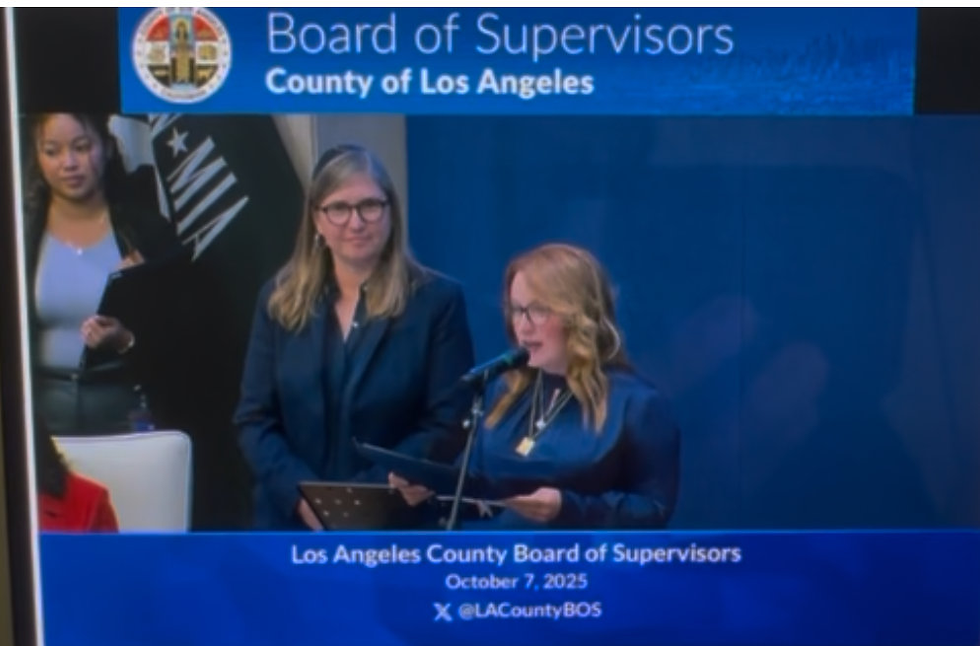
The morning of October 7, Rabbi Miller, founder of Keeping It Sacred, delivered the invocation for the Los Angeles Board of Supervisors meeting. The video from the invocation can be seen on Instagram HERE, or also available on YouTube here (at the beginning): HERE. It was also covered by the news HERE and HERE and HERE.
The words she shared are here:
I want to express gratitude to you
and the entire board for inviting me here
to deliver the invocation,
especially on
such a significant day.
I invite you to assume a
position of prayer if
it is your custom:
Respected leaders of this
beloved county of Angels,
residents and visitors,
I am grateful
this day to gather with you.
Today is the first day of a Jewish holiday known as Sukkot.
A holy day that remembers when
the Israelites dwelled in huts
along their journey through the desert
over 3,000 years ago.
This week, members of the Jewish community
are commanded to dwell in the sukkah
which is a structure that is commanded
to have a roof but one that must be more open
than it is closed.
When we dwell in the Sukkah,
we are reminded of the
tenuous nature of existence.
We are reminded of the fragility of life,
subjected to the howling winds,
bright sun, and rains,
including the wind, sun and rain
forecasted for this region this week.
This is a week when we feel our vulnerability.
Two years ago today,
October 7, 2023,
the Jewish community felt
the startling vulnerability of life,
having witnessed on television
the gruesome slaughter of 1200
of our coreligionists and others
in Israel.
The images in vivid color
awakened generational trauma
many of us hadn’t felt in our lifetimes.
And we know that
those who weren’t murdered that day
were taken hostage in the days since,
dwelling lives of fragile tenuousness,
subjected to the whims of their captors
every second, every minute, every day
for 727 days now.
And their days are still not guaranteed.
Those in Israel are endlessly subjected to
sirens that alert the community
of incoming rockets and
indiscriminate
terror attacks.
No one should live that kind of tenuous existence.
These days I am also feeling
the chilling vulnerability of
the surviving Gazans
who dwell in huts of their own
made of reclaimed rubble and scrap metal
resourced from bombed out buildings,
and repurposed tarps from aid packaging,
dwelling on a literal battlefield.
Hundreds of thousands of civilians
struggling to survive continued threats
from every side.
No one should live that kind of tenuous existence.
Leaders are meant to protect their people
from that kind of fragility of life.
To provide basic sustenance
and infrastructure
that provides pipelines to advancement.
To insure domestic tranquility,
promote the general welfare,
and to provide for the common good.
And so, today, here in Los Angeles,
I lift up a prayer
for the esteemed members of this body,
the Los Angeles Board of Supervisors.
May you nurture that call to protect the community
from the harsh winds of indifference,
to protect residents here from
the reign of greed,
and the blazing heat of hatred.
May you make decisions that
contribute to the stability
and flourishing of all in the region
regardless of race, religion, age, creed,
sexual orientation, status, income, ability,
national status, or primary language,
so that all may be
not only tranquil
but so that all
may thrive.
And may you be blessed as you do so. Amen.
For more information, please see the full newsletter and our full newsletter archive at keepingitsacred.com/news
And to sign up for the newsletter every week, please sign up at the bottom of the page in the purple boxes-- we just need your name and email address.
Thanks for your interest, and thanks for #keepingitsacred…


